
The Final Expense Blueprint: How One Independent Agent Turned $500 into $12,000 in Annual Premium
Last Updated on April 4, 2026 by bail_admin
The life insurance industry is often divided into two camps: those who wait for the perfect, high-priced “live transfer” lead, and those who understand that the real gold is buried in the volume of aged data. For independent agents specializing in Final Expense (FEX), the cost of acquisition is the single biggest hurdle to scaling.

When you are buying fresh, exclusive direct mail leads at $35 to $45 a pop, your margins are razor-thin. One bad week can put a solo producer in a financial hole that takes a month to dig out of.
Today, we are breaking down a case study of an agent, let’s call him “Mark”—who decided to pivot his strategy. Instead of competing for the same “hot” leads as every other captive agent in the country, Mark focused on high-volume, aged FEX leads.
Here is exactly how he structured his campaign, the math behind his ROI, and the workflow he used to turn “old” data into fresh commissions.
The Profile: A Solo Agent in the FEX Trenches
Mark is an independent producer who has been in the insurance game for three years. He’s a grinder. He doesn’t have a massive call center or a team of setters; he has a laptop, a CRM, and a headset.
The Challenge: Mark was spending nearly $2,000 a month on fresh Facebook leads. While the quality was decent, the volume wasn’t high enough to keep his calendar full. He found himself “cherry-picking” and waiting for the phone to ring, rather than staying in an active selling state.
The Pivot: Mark decided to allocate a portion of his marketing budget—specifically $500—to aged Final Expense leads (data 90–180 days old). His goal was to see if he could achieve a lower Cost Per Acquisition (CPA) by outworking the data rather than outspending the competition.
The Strategy: Volume Meets Persistence
The mistake most agents make with aged leads is treating them like fresh leads. They call once, don’t get an answer, and mark the lead as “dead.”
Mark’s approach was different. He treated the aged data as a “contact sport.” He knew that these individuals had expressed interest in Final Expense coverage a few months ago. Perhaps they didn’t buy then because of a timing issue, a bank account problem, or simply because they were overwhelmed by the initial influx of 50 agents calling them at once.
By entering the picture 90 days later, Mark was often the only person calling. He wasn’t competing with the noise; he was providing a solution to a problem that hadn’t gone away.
The Breakdown: By The Numbers
To understand why this works, we have to look at the raw data. Mark’s campaign lasted 30 days. He spent his $500 on a batch of approximately 500 aged FEX leads (priced at roughly $1.00 per lead).
1. The Funnel Metrics
- Total Leads Purchased: 500
- Total Investment: $500.00
- Total Dials Made: 1,850 (averaging 3.7 attempts per lead)
- Contact Rate: 15% (75 people reached)
- Appointments Set: 18
- Presentations Completed: 12
- Total Policies Written: 8
2. The Conversion Math
Mark’s contact-to-close ratio was roughly 10.6%. Because these were aged leads, the “no-show” rate for appointments was slightly higher than fresh leads, but the people who did show up were serious. They had already been through the “tire-kicker” phase months ago.
3. The Financial ROI
- Average Annual Premium (AP): $1,500 per policy
- Total AP Written: $12,000 (8 sales x $1,500)
- Average Commission (100% Street Level): $12,000
- Marketing Cost: $500
- Net Profit (Pre-expenses): $11,500
- Return on Ad Spend (ROAS): 24x
While a 24x return is exceptional, it’s important to note the “sweat equity” involved. Mark didn’t just buy the leads; he hammered the phones. His cost per acquisition (CPA) was a staggering $62.50 per sale. Compare that to fresh direct mail leads, where the CPA often hovers between $250 and $400.
Check out this script here for FEX that Mark used
The Workflow: How Mark Beat the “Aged” Label
Success with aged FEX leads isn’t about luck; it’s about a repeatable system. Mark followed a specific “Triple-Touch” cadence for the first 48 hours of receiving his data:
Day 1: The Initial Blitz
- Morning: Manual dial. If no answer, no voicemail.
- Afternoon: Manual dial. If no answer, leave a brief, professional “benefit-driven” voicemail.
- Text: Follow up the voicemail with a simple SMS: “Hi [Name], this is Mark. I’m following up on your request for the state-regulated final expense programs. I have the updated 2026 rates for you. Give me a call back at [Number].”
Day 2: The Soft Follow-Up
- Mid-Day: One dial. If they answer, the script is focused on “the update.”
- Script: “Hi [Name], I’m the regional specialist for the senior benefits program. You had looked into this a few months back, and my records show you never received your physical voucher for the 2026 rate lock. I’m just calling to verify your address so I can get that out to you.”
By focusing on “The Update” or “The Voucher,” Mark bypassed the “I already took care of that” objection. Even if they had already purchased a policy, Mark would offer a “policy review” to ensure they weren’t overpaying—a tactic that led to two of his eight sales.
Lessons Learned: Why This Campaign Succeeded
Looking at Mark’s results, three factors stand out as the “Difference Makers”:
1. The “Re-Shop” Mentality
In the FEX market, many seniors buy the first policy offered to them by a captive agent. These policies are often more expensive or have waiting periods. Mark’s value proposition was simple: “Now that the dust has settled, let’s see if I can find you a better rate or more coverage for the same price.”
2. Speed to Dial (Even for Aged Data)
Even though the leads were 90 days old, Mark treated them as “new to him.” He loaded them into his power dialer and began calling within minutes of the purchase. The “aged” leads are only dead if they stay sitting in your inbox.
3. Multichannel Outreach
Seniors are increasingly tech-savvy. Mark found that 30% of his appointments were set via text message follow-ups. By using a combination of calls, voicemails, and SMS, he stayed top-of-mind without being perceived as a “telemarketer.”
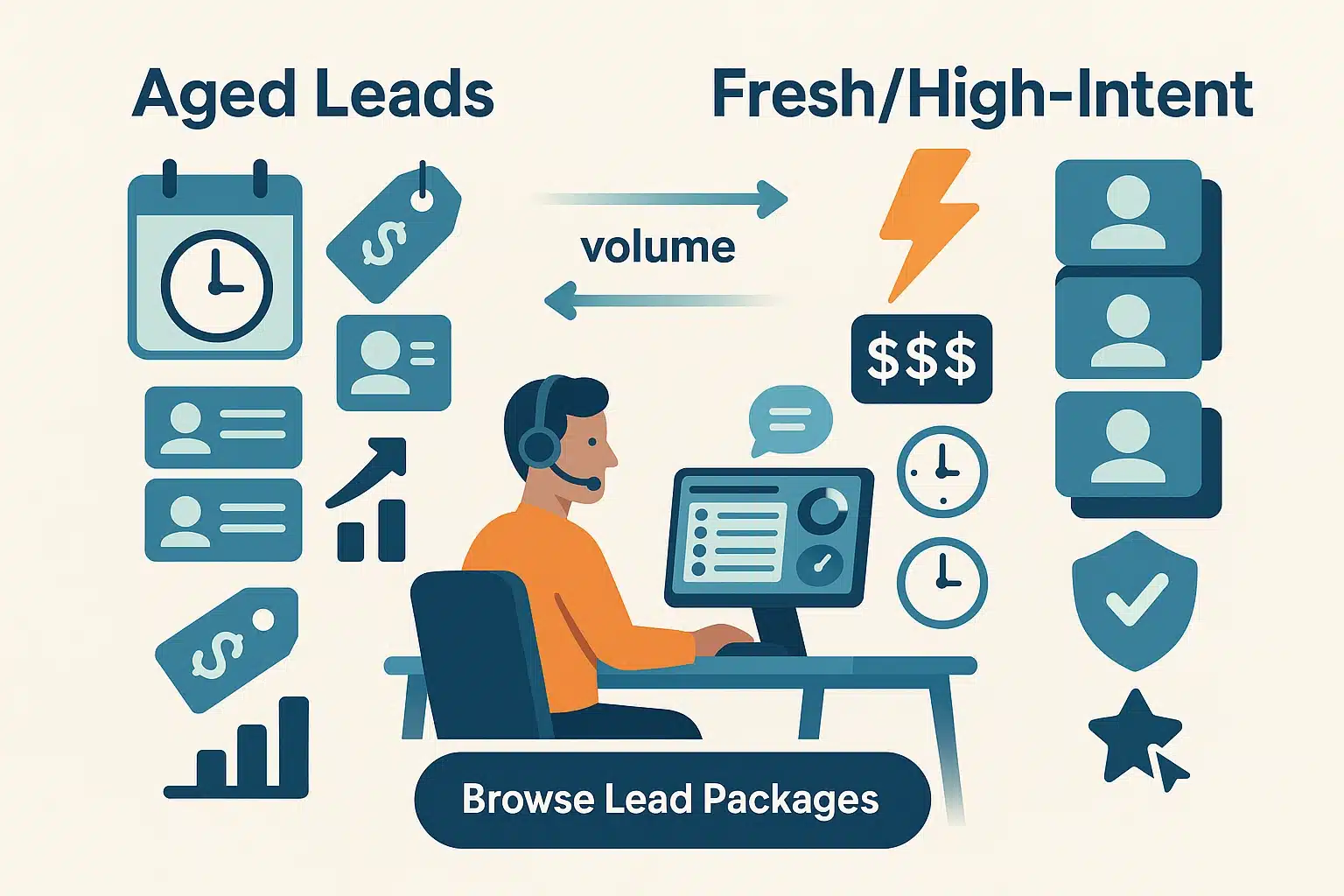
The Comparison: Aged vs. Fresh
| Metric | Fresh FEX Leads | Aged FEX Leads (Mark’s Results) |
| Lead Cost | $35.00 | $1.00 |
| Volume for $500 | 14 Leads | 500 Leads |
| Dials Required | Low | Very High |
| Competition | High | Low/None |
| CPA (Cost Per Sale) | ~$300.00 | $62.50 |
The data is clear. Fresh leads are a “sprint”—they require immediate response and high closing skills. Aged leads are a “marathon”—they require high volume and persistence. For an agent like Mark, who has more time than capital, the aged lead model provided the leverage he needed to gross $12k in a single month from a $500 start.
Conclusion: Is This Model Right For You?
If you are an agent who hates the phone, aged leads will be your personal version of hell. But if you view your insurance business as a math equation, the results are undeniable.
Mark didn’t find “better” people; he found a more efficient way to buy his way into a conversation. By lowering his lead cost to $1.00, he removed the “fear of failure” from every dial. He could afford to have 400 people tell him “no” because the 8 people who said “yes” created an 11,500% return on his marketing spend.
Ready to build your own case study?
The formula is simple: Buy the volume, work the system, and stop overpaying for “fresh” air.